Blog › Foundations

Competitive intelligence:
From signals to decisions

Today any company can track moves by competitors, markets, regulation or technology. The challenge arises when all those signals compete for attention and the same development can have very different implications depending on who receives it.

By Rut Bei Subirat Domènech, Product Owner at EnGuaita · 3 min read
In this article

Key idea

Detecting a signal is only the beginning. What matters is understanding what it means for your organization and what is worth reviewing from there.

Detecting is not understanding

Tracking the competition can help you know what has changed.

A new launch. A change in messaging. A new offering. A commercial move.

That information is useful, but on its own it still doesn’t answer the most important question: what does this mean for us?

That is why detecting and gathering information is not enough. Signals need context to become useful intelligence.

Context and objectives

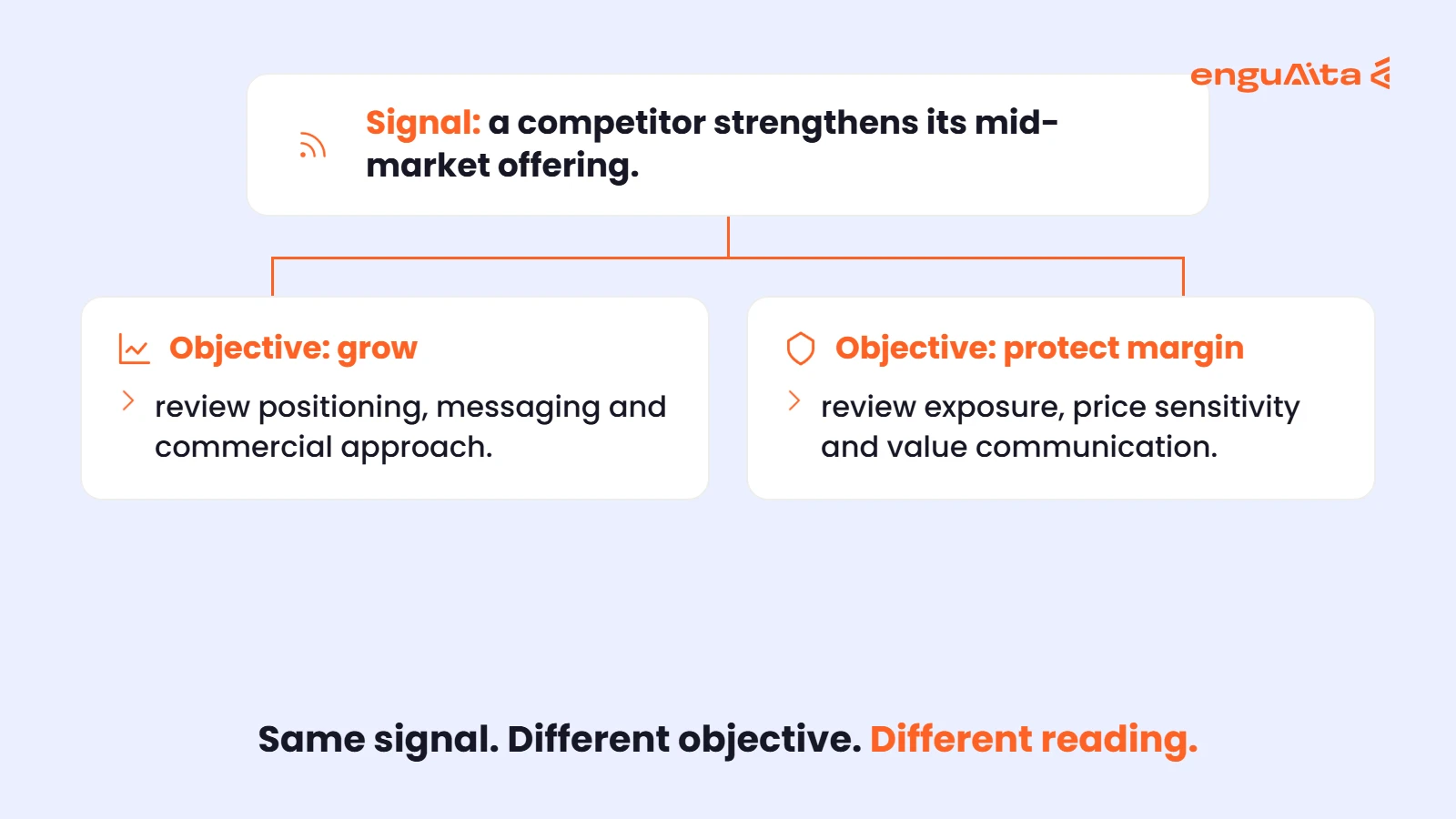
Example of the same competitive signal interpreted according to two different objectives.

The same signal can have different implications depending on the organization and the objective from which it is interpreted.

Imagine a competitor launches a new offering aimed at the mid-market segment.

If your objective is to grow in that segment, it may justify reviewing positioning, messaging or commercial approach.

If your priority is protecting margin and retention, the same move may lead you to review other issues.

The signal hasn’t changed. The context and the objective have.

That connection is a central part of EnGuaita: understanding each organization’s reality to assess which signals deserve attention and why.

Where AI comes in

AI can detect changes and summarize large amounts of information.

But for a recommendation to be useful, it needs to understand the context in which the decision is made.

EnGuaita connects the signal with the configured context and objectives to assess its relevance, explain why it may matter and point to what is worth reviewing.

The goal is not to stop at “what happened?”, but to move towards “why might it matter and what is worth reviewing?”

Preparing the response

Understanding what is worth reviewing doesn’t always finish the job.

Starting from a recommendation, you may need to cross-check information, compare alternatives or prepare arguments and documents before deciding.

EnGuaita can also help with that step through its agent.

AI guides, prepares and proposes. The person or team decides what to execute.

From signal to decision

The journey can be summarized like this:


Signal
›Context + objective›Relevance + impact
›What to review›Preparation›You decide

EnGuaita helps you go through that process with more context, but the final decision remains with the person or team.

Not every signal requires action.

Sometimes the best decision will be to dig deeper, observe, wait or do nothing.

The value lies in reducing the work between detecting what is happening and reaching a decision with enough context.

Give us a real signal from your market and an objective. We'll show you how EnGuaita would interpret it in a tailored demo.

Frequently asked questions

Monitoring helps detect changes. Competitive intelligence adds context and interpretation to understand why a signal may matter and what is worth reviewing.

No. EnGuaita can guide, propose and help prepare a response, but the person or team reviews the result and decides what to execute.

Keep reading